Express Bus Terminal Triple Panorama Ads | Sound DOOH
2026년 07월 30일
스크린도어 광고 1234호선
2026년 08월 21일Apartment Elevator Advertising in Korea: Reaching 5.1 Million Residents Through One Media Category

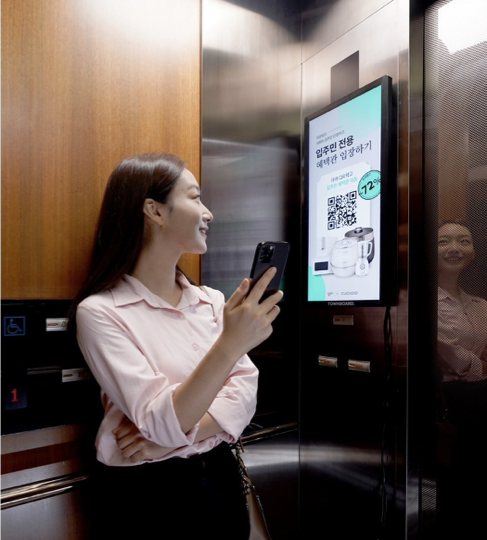
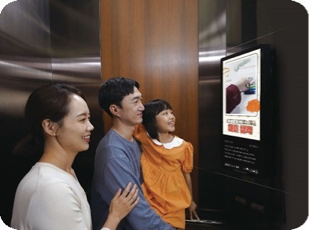
Some apartment complexes in Korea have digital screens installed inside the elevator cabin.
Residents pass in front of these screens every day, during the commute out in the morning and back home in the evening.
This network is known as Town Board, installed across 3,200 apartment complexes nationwide on 57,400 elevator devices.
Within the category of in-complex advertising, no comparable competing format exists at this scale.
Screen Specs and Installation
The network runs on two screen types, split by where they sit inside the building.
The primary format, installed inside roughly 50,000 elevator cabins, is a 25-inch vertical display at 1,080×1,920px, divided between an ad zone on top and a live news and weather information zone below.
A secondary format, installed in about 7,000 elevator hall waiting areas, is a larger 50/55-inch display at 1,080×2,560px that combines a community bulletin board with a dedicated ad zone.
| Item | Detail |
|---|---|
| Cabin display (S-type) | 25-inch, 1,080×1,920px, ad zone + news/weather zone — approx. 50,000 units |
| Hall display (L-type) | 50/55-inch, 1,080×2,560px, bulletin board + ad zone — approx. 7,000 units |
| Creative length | 15 / 30 / 45 / 60 seconds |
| File spec | MP4, under 2.5GB, 4,096kbps bitrate |
| Operating hours | 06:00–24:00 (18 hours/day) |

Exposure Mechanism
Exposure happens inside a closed, repeat-use space rather than along an open street corridor.
A resident rides the elevator at least twice a day, and often more once grocery trips, deliveries, or school pickups are added in.
Unlike a roadside placement where a passerby may see an ad only once, elevator advertising accumulates frequency with the same household over the length of a campaign.
The audience is defined by the address rather than by an individual, so campaigns are scoped by administrative district instead of trying to isolate a specific consumer — a different targeting logic than open-street outdoor media.
Package and Pricing Structure
Unlike most outdoor media, this network cannot be booked for a single complex on its own.
Inventory is sold as regional packages — nationwide, Seoul metro, or a regional group — or as per-device units within specific districts such as Gangnam or Seocho.
As a reference point, the full nationwide package runs at approximately KRW 150,000,000 per month, guaranteeing coverage across all 57,400 devices.
Actual cost depends on the region covered, the guaranteed device count, and the package combination — Seoul-metro-only or district-unit entries are priced differently. Contact MBSTAR for a quote scoped to your target region and budget.
Nationwide Coverage
The network covers 2.03 million households, translating to an estimated 5.1 million residents reached across the full footprint.
Coverage concentrates most densely in Seoul’s Gangnam and Seocho districts, where district-unit buying is available separately from the regional packages, alongside Songpa, Yangcheon, and other major metro regions.
This is a residential-address-based network rather than a foot-traffic corridor, so its coverage logic differs from transit or roadside media — it reaches people specifically inside the homes they already live in, not commuters passing through a location.
| Scope | Coverage |
|---|---|
| Nationwide | 3,200 complexes, 57,400 devices, 2.03M households |
| Seoul metro | Available as a standalone regional package |
| Gangnam / Seocho | Available as district-unit, per-device entry |
| Songpa / Yangcheon / other metro | Available as district-unit, per-device entry |
Creative Guidelines
Because the S-type cabin display splits screen real estate between the ad zone and a live information ticker, creative should be readable within a compressed vertical frame rather than designed for a full-bleed layout.
The L-type hall display gives more room but is viewed from a standing position at a short distance, so text size and contrast matter more than they would on a roadside billboard.
Sixteen ad categories are restricted on this network, including alcohol, consumer lending, adult content, political, and religious advertising. Screening happens before contract signing, so it’s worth confirming category eligibility early in the planning process.
Target Categories and Brand Fit
Data collected across installed complexes shows resident households with an average monthly income of KRW 6.34 million, about 6.4% higher than non-installed complexes, and a shopping engagement rate of 78%, about 5 percentage points higher (media data, 2024).
Brands that have run campaigns on the network report an average 1.6x lift in brand awareness among exposed households (media data, 2024).
This profile fits premium beauty, baby and kids products, home appliances, health and wellness, education, and interior/real estate brands particularly well — categories where a household-level, repeat-frequency touchpoint outperforms a single street-level impression.
| Item | Detail |
|---|---|
| Resident income index | KRW 6.34M/month avg., +6.4% vs. non-installed complexes |
| Shopping engagement | 78%, +5pp vs. non-installed complexes |
| Brand awareness lift | Avg. 1.6x among exposed households |
| Best-fit categories | Premium beauty, baby/kids, appliances, health/wellness, education, interior/real estate |
| Restricted categories | 16 categories excluded — alcohol, lending, adult, political, religious, etc. |
FAQ
It’s sold as regional packages, or as per-device units within select districts like Gangnam and Seocho. Contact MBSTAR to scope the smallest available entry point for your target region.
Category screening happens during the proposal stage.
Get a Region-Scoped Quote
Pricing depends on the region, guaranteed device count, and package combination you need. Tell MBSTAR your target region and budget, and we’ll scope a Town Board package that fits.
MBSTAR | ☎ 010-8928-0621
Media Worth Reviewing Together
Outdoor Advertising CPM Efficiency Guide breaks down how to compare reach economics across different outdoor formats, useful context when weighing a household-based network against street-level media.
Roadside Bus Shelter Digital Advertising Price Guide covers another packaged-inventory transit format if you’re comparing structured, district-based buying options.
(Household statistics reference: KOSIS Korean Statistical Information Service — verify the latest figures before publishing.)
apartment elevator advertising, elevator ad network Korea, in-lift advertising, residential digital signage, apartment complex advertising, elevator TV ads Korea, household reach media, Gangnam apartment advertising, Seocho apartment advertising, Songpa apartment advertising, premium beauty advertising Korea, baby product advertising Korea, home appliance advertising Korea, health wellness advertising, education brand advertising, interior real estate advertising, brand awareness campaign Korea, residential advertising network, DOOH advertising Korea, digital out-of-home Korea, OOH advertising Korea, elevator digital signage, outdoor advertising inquiry, outdoor media inquiry, Gangnam billboard advertising, Gangnam-daero billboard advertising, Gangnam station billboard advertising, Samsung station billboard advertising, COEX billboard advertising, Hongdae billboard advertising, Hongik-univ billboard advertising, Seoul billboard advertising, Seoul outdoor advertising, Seoul public institution advertising, government enterprise advertising, public institution advertising, local government advertising, Gwanghwamun public institution advertising, Gwanghwamun billboard advertising, Yeouido billboard advertising, Jamsil billboard advertising, Konkuk billboard advertising, Sinchon billboard advertising, Seongsu billboard advertising, Mapo billboard advertising, Yongsan billboard advertising, Myeongdong billboard advertising, subway station advertising, subway advertising inquiry, bus shelter advertising, MBSTAR